


MBA. Hellen Ruiz Hidalgo
Strategic Communicator
Foreign Trade Observatory (OCEX)
Vice-Rectory for Research - Distance Learning State University (UNED)
Introduction. This Capsule No. 2-2026 will analyze, from an integral perspective, the historical evolution of digital technologies in trade, their structural effects on the global economy, and the primary challenges the multilateral system faces in this new reality. It will address both the technological instruments that have marked the transformation of trade and the regulatory and security implications emerging from their implementation. Special attention will be devoted to the phenomenon of cybersecurity and the role that the World Trade Organization (WTO) can play in building a balanced regulatory framework. Such a framework should regulate trade without hindering it, ensuring legal certainty and digital protection without turning these norms into disguised technical barriers that distort global trade. This will be addressed in greater depth in a future capsule.
Contemporary trade is immersed in an unprecedented structural transformation driven by the systematic revolution of digital technologies. What began as a progressive modernization of communication and data processing systems has evolved into a comprehensive reconfiguration of the global economy. Production, distribution, exchange, and the consumption of goods and services are now deeply interconnected with digital infrastructures that determine the speed, efficiency, and reach of international trade.
Scientific advances in computing—in both hardware and software—have been accompanied by the universalization of access to smart devices, high-speed networks, and increasingly sophisticated data management systems. This socio-technological convergence has generated a new commercial architecture based on industrial automation, digital interconnection, and the massive analysis of information in real-time. Trade is no longer defined solely by the physical movement of goods, but by the uninterrupted flow of data that organizes, optimizes, and predicts every link in the value chain.
An Integrated Digital Ecosystem Reduces Costs and Redefines International Trade. Digital technologies have drastically reduced transaction costs historically associated with commercial exchange. Gone are paper documentation, physical intermediation, manual customs procedures, bank verifications, and prolonged processing times. Digitalization has allowed the replacement of analog processes with electronic platforms that operate on a global scale with exponential efficiency. Thus, e-commerce, digital payment systems, cloud computing, Big Data analysis, blockchain, and Artificial Intelligence are not isolated innovations, but components of a digital ecosystem that redefines the rules of international economic exchange. These are technological instruments that continue to transform both logistics and trade regulations themselves. Abuzar Zeya explains, for example, how IBM’s TradeLens—a blockchain-based platform—“digitizes supply chain documentation, reducing delays caused by manual customs processes.” (1)
Evolution of the Impact of Digital Technologies on Trade. The digital transformation of trade can be understood as a paradigm shift. A paradigm shift occurs when traditional trade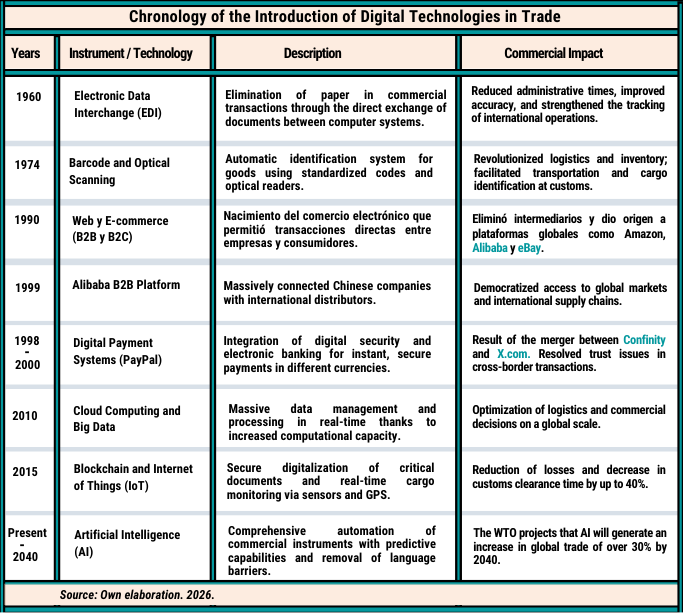 is contrasted with trade facilitated by digital technologies. The traditional model was based on physical exchanges supported by material documentation, hierarchical structures, and the use of third-party intermediaries, added to the movement of payment methods through banking services and intermediation chains that increased costs and time.
Each of these elements added to production and transport costs, making up the set of elements referred to by the general term "transaction costs." In contrast, contemporary digital trade relies on decentralized networks, electronic platforms, and automated processes that allow direct transactions between companies (B2B), as well as between companies andconsumers (B2C), without the need for a physical presence in the origin or destination markets. This transition has expanded access to global markets, especially for small and medium-sized enterprises, reducing historical barriers to entry for both businesses and end consumers.
66 Years of Digital Technologies that Transformed Trade. The year 1960 is considered the starting point for the digital transformations that impacted world trade. Around that year, paper for the exchange of commercial communications was replaced by the introduction of Electronic Data Interchange (EDI). Ten more years passed before the introduction of the barcode and optical scanning revolutionized all inventory control systems, logistics, and customs procedures.
In the 1990s, the emergence of the World Wide Web consolidated e-commerce as a structural phenomenon by enabling platforms such as Amazon and eBay, which allowed access to global markets without a physical presence. Subsequently, digital payment systems like PayPal facilitated cross-border transactions, while cloud computing and Big Data optimized logistics and strategic planning for international trade.
Since the beginning of the 21st century, digital technologies have further redefined international trade: smartphones integrated small businesses into global markets; blockchain secured the digitalization of commercial documents for maritime trade; the Internet of Things (IoT) allowed for the real-time monitoring of goods on a global scale; and today, Artificial Intelligence drives a more agile, interconnected, and data-driven globalization.
This century has witnessed further progress with B2B (Business to Business) platforms and B2C (Business to Consumer) models, which represent the direct digital relationship between a company and the end consumer. In the following table, we present each digital instrument/technology chronologically.
The Cumulative Impact of These Technologies. The transformations generated in trade are not limited to operational efficiency; they project a systematic expansion of digital services in commerce. In 2023, digitally delivered services accounted for 13.8% of total global exports. (2)
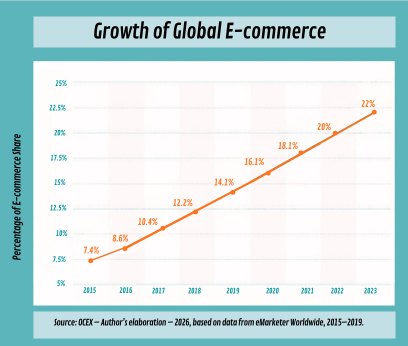 Regarding cost reduction, the digitalization of trade offers substantial efficiency gains: according to the WTO, the full digitalization of trade documents can reduce transaction costs by up to 80%. Furthermore, the WTO projects that digitalization will add an additional 2% to global trade growth annually during the current decade. (3)
However, these benefits are distributed unevenly: while in developed economies digital services represent up to 60% of their service exports, in developing countries this figure barely reaches 15%. This disparity underscores the urgency of closing the technological gap to ensure that the benefits of digitalization are distributed equitably on a global scale.
This gap is not solely due to technological limitations, but also to regulatory, institutional, educational, and infrastructural factors, forming a myriad of relevant structural challenges in contemporary international trade. This context explains the current configuration of digital trade, its trends, and the social, political, legal, and economic barriers that condition the expansion of its benefits.
Nevertheless, the rapid spread of smartphones and internet access demonstrates that technological and cost limitations are no longer the primary obstacle. Today, gaps in digital trade are mainly driven by political decisions and regulatory frameworks rather than technical restrictions.
Challenges posed by Digital Technologies in trade. Like any innovation process, the incorporation of digital technologies in trade has been uneven and asymmetrical, generating adaptation challenges—especially in developing countries—with regulatory, operational, and institutional hurdles ranging from insufficient legal frameworks to capacity limitations in managing risks.
In the cross-border flow of data, governments impose policies that can be restrictive. Challenges also arise from mandatory data localization policies. Simultaneously, regulatory differences in data protection create legal uncertainty. Furthermore, the imposition of tariffs on digital platforms introduces new trade tensions, and the absence of harmonized international standards hinders global interoperability. Added to this is the growing concern over digital sovereignty and national security—elements that occasionally result in disguised protectionist measures. Shan He et al. explain that when these barriers are imposed by digitally advanced economies, they end up harming emerging countries that depend on developed economies. (4)
This represents a line of problems linked to the regulatory and tax world that are of great significance. However, cybersecurity is arguably one of the most critical challenges.
The Specific Problem of Cybercrime and Cybersecurity. Digital interconnection has increased the vulnerabilities of international trade, turning the expansion of cybercrime into one of the most lucrative illicit economies in the world. Its effects directly impact the stability of supply chains, the integrity of transactions, and business competitiveness. In this scenario, ensuring the confidentiality, integrity, and availability of information is an indispensable condition for operational continuity. Open economies face greater risks, as attacks on critical infrastructure or customs systems can paralyze trade flows, generate significant losses, and affect international trust.
Cybersecurity Protects Digital Information. In computing terms, cybersecurity has traditionally been described as the response to various threats and attacks against computer systems and networks. It is often encompassed in the "CIA triad," standing for Confidentiality, Integrity, and Availability—meaning the "preservation of the confidentiality, integrity, and availability of digital information and its underlying infrastructure." In clause 3.2.5 of its description of General Aspects of Cybersecurity, the International Telecommunication Union (ITU) formally defines cybersecurity as a "collection of tools, policies, security concepts, security safeguards, guidelines, risk management approaches, actions, training, best practices, assurance and technologies that can be used to protect the cyber environment and organization and user’s assets." (5)
In just ten years (2015-2025), the cybersecurity business decupled (10x). From being a $75 billion business in 2015, as recorded by Cybercrime Magazine (6), it grew into a market of $193.73 billion in 2024, according to Fortune Business Insights, 2025. (7)
Cyberattacks disrupt trade flows in many dimensions. One of the most severe is Supply Chain Disruption, beginning with digital aggressions against supplier companies, which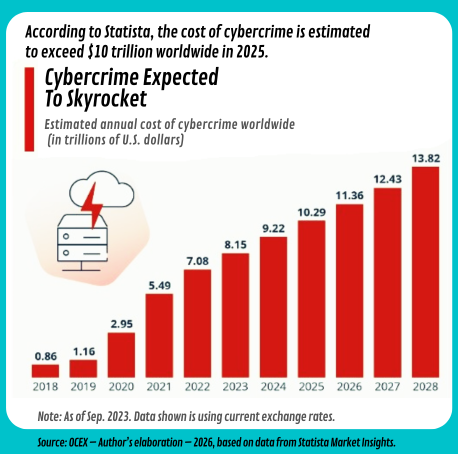 have been shown to paralyze global production. Statista Research Department, with 2024 data, reports that globally, 183,000 customers were affected by supply chain attacks. "The most common cyberattacks on customers included counterfeiting, drive-by compromises, and malware infections." The report Supply Chain Attacks: 2025 Analysis and 2026 Trends by Cipher (8), the cybersecurity division of Prosegur Group, reported that cyberattacks on the supply chain reached a global annual cost of $53 billion (9).
Maritime Cybercrime Affects Trade Efficiency (10). Cybercrime even produces insecurity in maritime transport through the manipulation of location, identity, or navigation data transmitted by a vessel for various forms of falsification. This activity is called AIS spoofing (Automatic Identification System). Unlike turning the system off ("going dark"), spoofing transmits false data, often to evade sanctions, hide illegal fishing, or circumvent maritime security. This is compounded by activities involving the interference or blocking of global positioning signals, known as GPS jamming, which compromises navigation and cargo safety. All of this results in a "cyber-distrust" that drives policies hindering trade and reducing efficiency.
The economic cost of cybercrime has scaled exponentially, with annual growth shown by a reported 75% increase in the third quarter of 2024 alone. Cybercrime is one of the largest illicit economies in the world. The scale of this crime can be appreciated considering that a cyberattack currently occurs every 39 seconds worldwide.
Cybercrime and its costs are onstantly increasing. To have an accurate idea of the severity of cybercrime, it is necessary to consider some quantitative assessments. According to IBM's Cost of a Data Breach 2024 report, the global average cost of each data breach has reached $4.88 million. Neha Mishra of the International Institute for Sustainable Development (IISD) confirms these figures and adds: “Cybersecurity threats are increasing in both scale and complexity, resulting in rising economic costs and posing significant risks to national security, political stability, and social systems.” (11)
Annual losses from cybercrime reach the trillions (12). Financial firms globally spend an average of $6.08 million dealing with data breaches. Yet, they are not the most targeted industry. Counterintuitively, attacks on healthcare were even more costly, with data breach expenses being the highest of any industry. By the end of 2025, annual global losses derived from cybercrime exceeded $10.5 trillion (yes, trillions). (13)
Cybercrime impacts stock market value. Companies with vulnerable networks record lower stock market performance. This affects shareholder returns and raises the risk of devaluation. Furthermore, following a security breach, 43% of affected companies lose a significant portion of their customer base. Added to every attack are high costs due to downtime, as operations are interrupted and significant losses are generated while the cybercriminal aggression is being resolved.
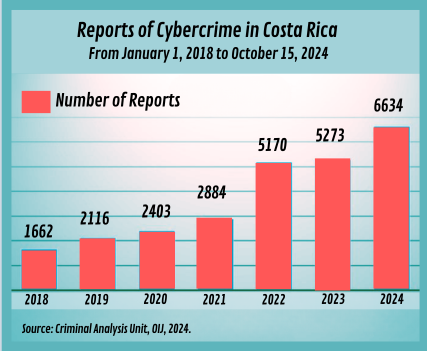
The impact of cybercrime in Costa Rica (14). Costa Rica has established itself as a critical target for cyber threats in the region, facing an impact that ranges from the paralysis of essential public services to massive economic harm to society. In 2024, the country recorded more than 10,040 cybercrime complaints, and in the first months of 2025, computer fraud accounted for more than 4,100 cases, with an estimated loss exceeding 200.6 billion colones. This phenomenon shows an alarming trend, with cybercrimes growing by 184% in the first four months of 2025 compared to the previous year. At the infrastructure level, the State invested approximately $25 million to recover systems following the 2022 ransomware attacks. These incidents caused operational losses in the productive sector of up to $30 million per day during the crisis. Facing these challenges, the country has bolstered its defenses.
Costa Rica fights cybercrime. The 2024 Global Cybersecurity Index gives Costa Rica a score of 75.07 (out of 100). However, the frequency of attacks remains massive. In the first half of 2025, there were nearly 30 million attempted attacks. (15)
The WTO facing the impact of digital technologies on trade. Digital trade is evolving faster than WTO negotiation processes, which remain anchored in 1995 rules. Its regulatory system was conceived in a pre-digital era and today faces tensions against new technological realities. Hence the profound structural challenge facing the WTO as it seeks to regulate its governance.
In the multilateral sphere, the governance of digital trade represents an existential challenge. The critical point is the lack of a global framework that clearly defines what constitutes a legitimate cybersecurity measure and what represents disguised digital protectionism, such as forced data localization or technological restrictions for national security reasons.
The absence of a binding global agreement on digital trade and cybersecurity is compounded by the paralysis of the dispute settlement system. This creates a "perfect storm" because the organization's ability to resolve controversies regarding technology transfers, data, or digital restrictions is limited, increasing the risk of regulatory fragmentation and the proliferation of regional agreements. This lack of consensus is exacerbated by the paralysis of its Appellate Body, which since late 2019 has lacked the quorum to hold sessions. This functional crisis has left international trade in a state of "legal vulnerability," where members can appeal panel reports "into the void," preventing disputes over technology transfer, digital intellectual property, or high-tech subsidies from reaching a final resolution.
Consequently, the dispute settlement system has lost its ability to act as an impartial arbiter, pushing nations to adopt unilateral measures or seek refuge in more agile regional agreements, which fragments the global trade ecosystem and weakens the WTO's relevance in the 21st-century economy.
In conclusion, analyzing the impacts and challenges of digital technologies in trade involves understanding the dual nature of this transformation. On one hand, it is a powerful tool for efficiency, expansion, and economic modernization. On the other, it generates regulatory tensions, systemic risks, and structural inequalities that must be addressed through coherent public policies and effective international cooperation.
In a subsequent OCEX Capsule, the current and prospective role of the WTO regarding the digitalization of trade will be examined, focusing the analysis on cybersecurity: both in protecting the reliable operation of digital technologies and in the international response to cybercrime. The core focus will be the multilateral system's capacity to articulate a strategic and balanced response to these challenges.
References:
- Abuzar Zeya. 22-09-2025. Transforming trade: The enduring impact of digital technologies on international commerce. International Journal of Law. En: https://www.lawjournals.org/assets/archives/2025/vol11issue9/11203.pdf
- Estadísticas. Conjunto de datos sobre el comercio de servicios suministrados digitalmente. Actualización de julio de 2025. En: https://www.wto.org/spanish/res_s/statis_s/gstdh_digital_services_s.htm
- Examen estadístico del comercio mundial de 2023. En: https://www.wto.org/spanish/res_s/booksp_s/wtsr_2023_s.pdf
- Shan He, Makoto Sakuwa, Anum Amin Kanjani. May 25th, 2020. Digital Economy Issues in the WTO’s Trade Policy Reviews. Brandeis University. International Business School. International Institutions Laboratory Student Team Project for the WTO Secretariat. En: https://www.brandeis.edu/global/faculty/student-research/papers/digital-economy-issues.pdf
- Recomendación UIT-T X.1205. En: https://www.itu.int/rec/t-rec-x.1205-200804-i/es
- Morgan Steve. 2020. Cybercrime to Cost the World $10.5 Trillion Annually By 2025. Special Report: Cyberwarfare In The C-Suite. Cybercrime Magazine. En: https://cybersecurityventures.com/cybercrime-damage-costs-10-trillion-by-2025/
- 2025. Cybersecurity Statistics 2025: Rising Threats and Industry Impact. En: https://www.fortinet.com/resources/cyberglossary/cybersecurity-statistics
- Statista Research Department. 2 de febrero de 2025. Global annual number of customers affected in supply chain attacks 2019-2024. En: https://www.statista.com/statistics/1375129/supply-chain-attacks-customers-affected-global/
- Cipher, división de ciberseguridad del Grupo Prosegur. 9 de febrero de 2026. Los ciberataques a la cadena de suministro se duplican en 2025 y alcanzan un coste anual global de 53.200 millones de dólares. En: https://www.novologistica.com/logistica/los-ciberataques-a-la-cadena-de-suministro-se-duplican-en-2025-y-alcanzan-un-coste-anual-global-de-53-200-millones-de-dolares/
- EsmaUflaz et. al. 24 de Marzo de 2024, Quantifying potential cyber-attack risks in maritime transportation under Dempster–Shafer theory FMECA and rule-based Bayesian network modelling. Revista Reliability Engineering & System Safety, Volume 243, March 2024, 109825. En: https://www.sciencedirect.com/science/article/abs/pii/S0951832023007391#
- Neha Mishra. 6 de agosto de Cybersecurity and International Trade: Understanding the policy landscape. IISD REPORT. BUILDING BLOCKS OF DIGITAL TRADE REGULATION SERIES No. 2 International Institute for Sustainable Development. En: https://www.iisd.org/system/files/2025-08/cybersecurity-international-trade-policy.pdf
- Informe del costo de una filtración de datos 2025. En: https://www.ibm.com/mx-es/think/insights/cost-of-a-data-breach-2024-financial-industry
- Brenda Camarillo. 25 octubre 2024. Costo global de los delitos cibernéticos superará los $10 billones para 2025 ¿Está su empresa realmente protegida? La República. Costa Rica. En: https://www.larepublica.net/noticia/costo-global-de-los-delitos-ciberneticos-superara-los-10-billones-para-2025-esta-su-empresa-realmente-protegida
- International Society Pulse. Costa Rica. https://pulse.internetsociety.org/en/reports/cr/
- Vega Briceño, Edgar. Estado de la ciberseguridad en Costa Rica 2024 / Edgar Vega Briceño et. al. Vicerrectoría de Investigación. Universidad Nacional, Sede Regional Chorotega. 2025. En: https://d38tduvovkr85r.cloudfront.net/wp-content/uploads/2025/05/UNA-LabCIBE-Estado-de-la-Ciberseguridad-en-Costa-Rica-2024.pdf